We find the cause, not just the symptom
Anyone can swap a breaker. The useful question is why it tripped in the first place. Diagnostics and repairs for Northern Colorado homes, with emergency service outside business hours.
Stop and read this first
If you see smoke or flame, get everyone out and call 911 — not us. If you smell burning plastic, see scorch marks or sparking at an outlet or panel, or a faceplate is hot to the touch, shut that breaker off at the panel and call us right away. Don't keep resetting a breaker that trips repeatedly; it's doing its job and telling you something is wrong.
The problems that show up most
Every one of these has a real cause that can be found. Guessing and replacing parts is expensive; testing is faster.
Breakers that keep tripping
Could be an overloaded circuit, a failing appliance, a short, or a genuine ground fault. Each one leaves a different signature and each has a different fix.
Dead outlets & switches
Usually a tripped GFCI somewhere unexpected, a failed backstab connection, or a broken splice in a box nobody has opened since 1978.
Flickering & dimming lights
Sometimes it's a cheap LED and the wrong dimmer. Sometimes it's a loose neutral, which is genuinely dangerous. Worth knowing which.
Burning smells & hot faceplates
Almost always a loose or arcing connection. This is the one where you shut the breaker off and call today rather than next week.
GFCI & AFCI that won't reset
Either the device has failed or it's correctly detecting a real fault downstream. Testing tells us which within minutes.
Failed inspection corrections
Selling or refinancing and the report came back with electrical items? We fix the list and document it so it clears.
Testing beats guessing, and it's cheaper
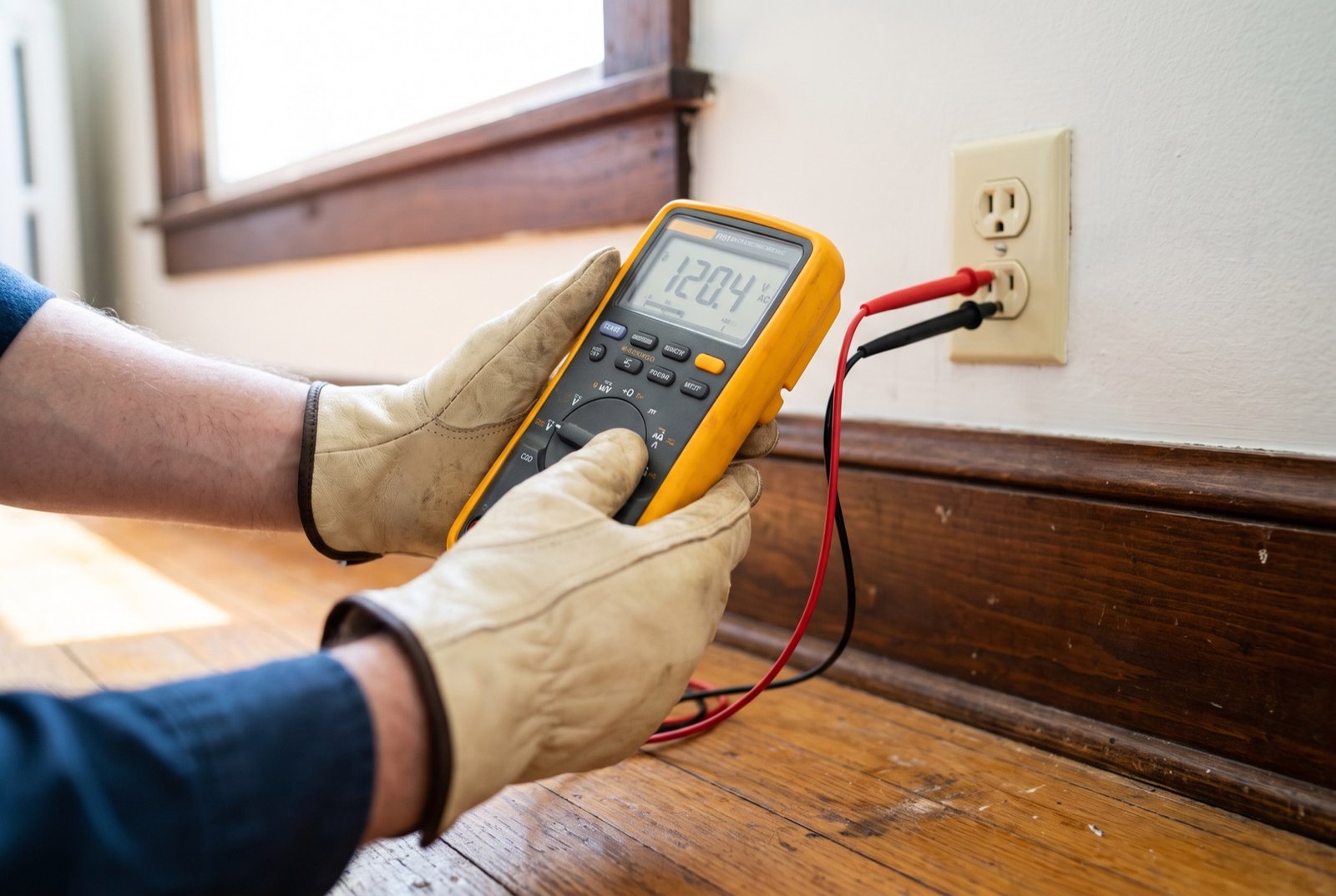
The expensive way to fix an electrical fault is to replace parts until it stops. We’d rather spend the first hour finding out what’s actually happening.
- Listen first — when it started, what's running when it happens, what changed recently
- Isolate the circuit — map what's actually on it, often not what the panel label claims
- Test under load — voltage drop, continuity, insulation resistance, thermal check
- Show you what we found — photos of the actual problem, not a verbal summary
- Quote the repair — and if it's something you can safely handle yourself, we'll say so

Knob-and-tube, cloth wire, and ungrounded outlets
A lot of Old Town housing stock predates modern grounding entirely. That doesn’t mean the house is unsafe — it means some specific things need attention and others genuinely don’t.
- Two-prong outlets replaced correctly, with GFCI protection where a ground doesn't exist
- Remaining knob-and-tube identified and evaluated honestly
- Deteriorated cloth-insulated wiring replaced section by section
- Aluminum branch wiring repaired with approved connectors
- Junction boxes brought up to code and made accessible
Before you call
What counts as an actual emergency?
Burning smells, sparking, scorch marks, a hot panel or faceplate, exposed live conductors, or losing power to something critical like a well pump or medical equipment. A single dead outlet in a guest room can usually wait until morning — and waiting costs you less.
Do you charge a diagnostic fee?
Yes, for troubleshooting calls — because finding the fault is the work. It’s a flat fee we quote before we come out, and we credit it toward the repair if you have us do it. Estimates for planned installation work are free.
Can you tell me what's wrong over the phone?
We can often narrow it down and tell you whether it’s urgent, and we’ll happily walk you through checking your GFCIs before you spend money on a visit. What we won’t do is diagnose a fault we haven’t tested.
My whole house lost power. Is that you or the utility?
Check your neighbors first. If the street is dark, it’s the utility — report it to them. If it’s only your house, or only half your house, that points to a main breaker, service conductor or meter problem, and that’s ours.
Something not working right?
Call and describe it. We’ll tell you honestly whether it can wait.